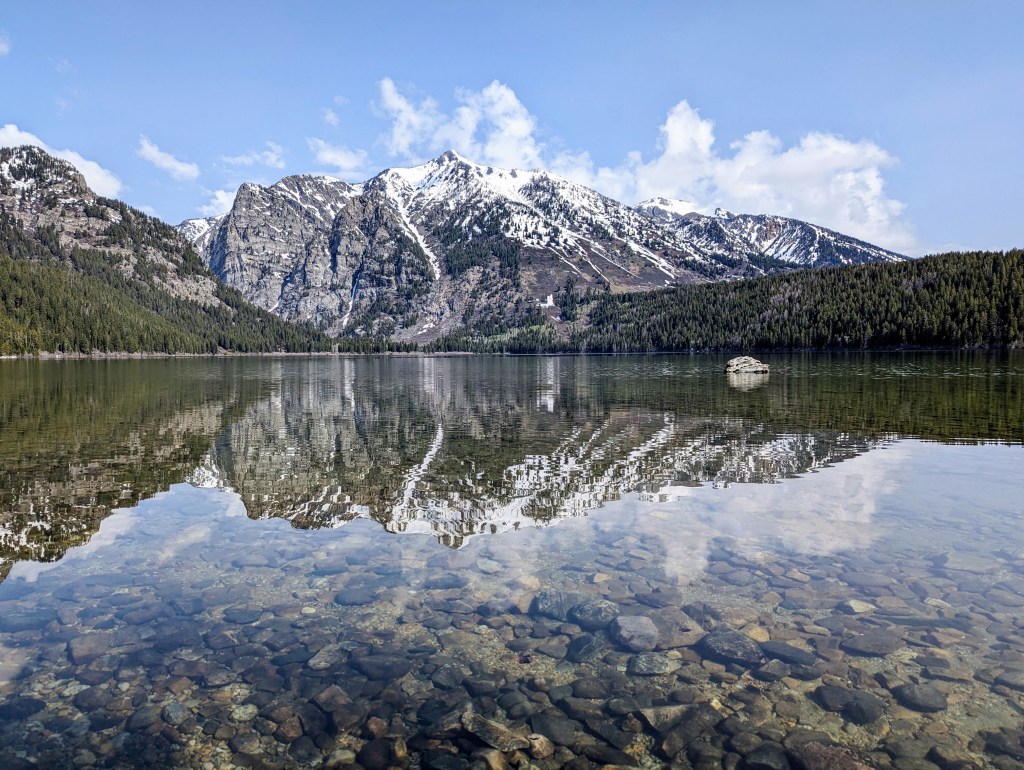
She looked up at the ridge in the distance. The overlook was there, above some switchbacks visible on exposed parts of the slope.
If the weather held she could reach it and be back before dusk, with a side trip into Death Canyon. This early in the season, snow still covered much of the trail on that side of the valley. So a foray into the canyon would be short, curtailed once footing became too difficult.
Megan had been at Phelps Lake before, with her son Aaron in tow. Their visits ran a gamut of his young existence over the years – from an infant mostly carried on her back, into his teens.
How would she do today, without him for the first time? Would she be sad, or would she find happiness knowing that her job was done, and that the boy was now a man?
The forest canopy broke and her shoulders felt the full sun, despite a wide-brimmed hat. Aaron had complained of the heat at this very spot – then they were here in late summer, when the sun’s rays had been intense.
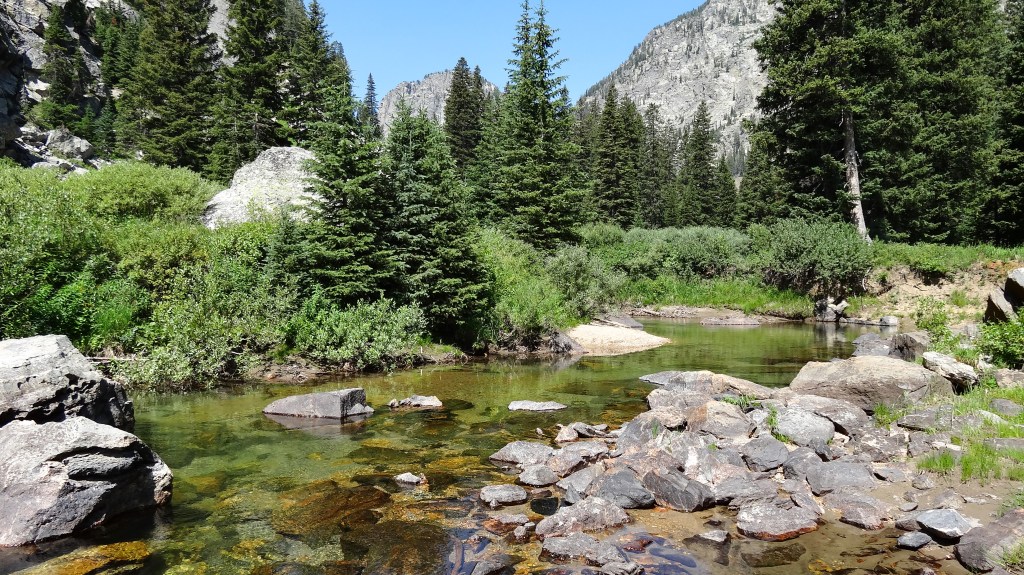
At a fork she turned to follow a narrow path toward Death Canyon. After a while, a large rock esplanade appeared just off the trail. Megan turned down the spur and was soon sitting on the stone’s expansive surface, peering alternatively into the stream below and to the mountain above as she drank from a water bottle.
With Aaron she sat here to eat lunch on their first visit. In the years that followed they made it further up the canyon before eating, but would usually stop here anyway, for a water break. On their last visit together Aaron’s pace had grown to match hers, and they walked past this alcove without stopping – both coming and going.
“Remember we used to sit there for a break?”
Now there was melancholy. Those good days could not be recaptured. Aaron was away at college, and their hikes together were done.
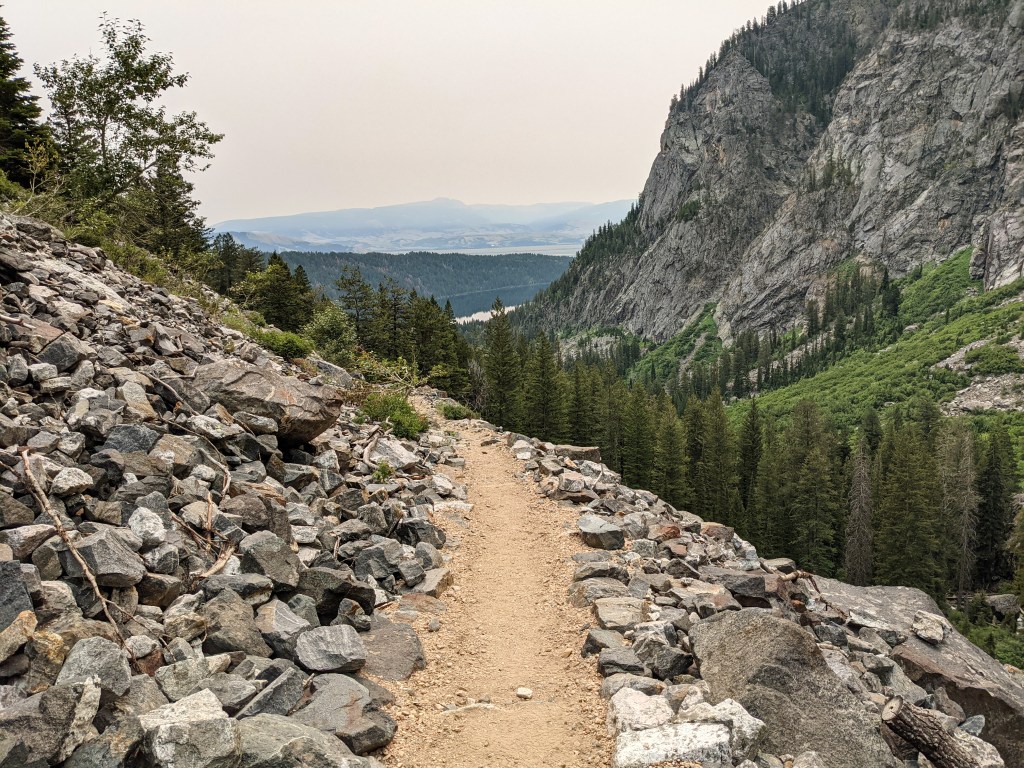
Megan gathered her pack and headed to the other side of the valley, turning up the rise to the overlook.
Two moose were the only things moving besides herself on this segment. She talked to each in turn as she passed them. A final burst of walking brought her to the ridge.
“Phelps Lake Overlook. Elevation 7200.”
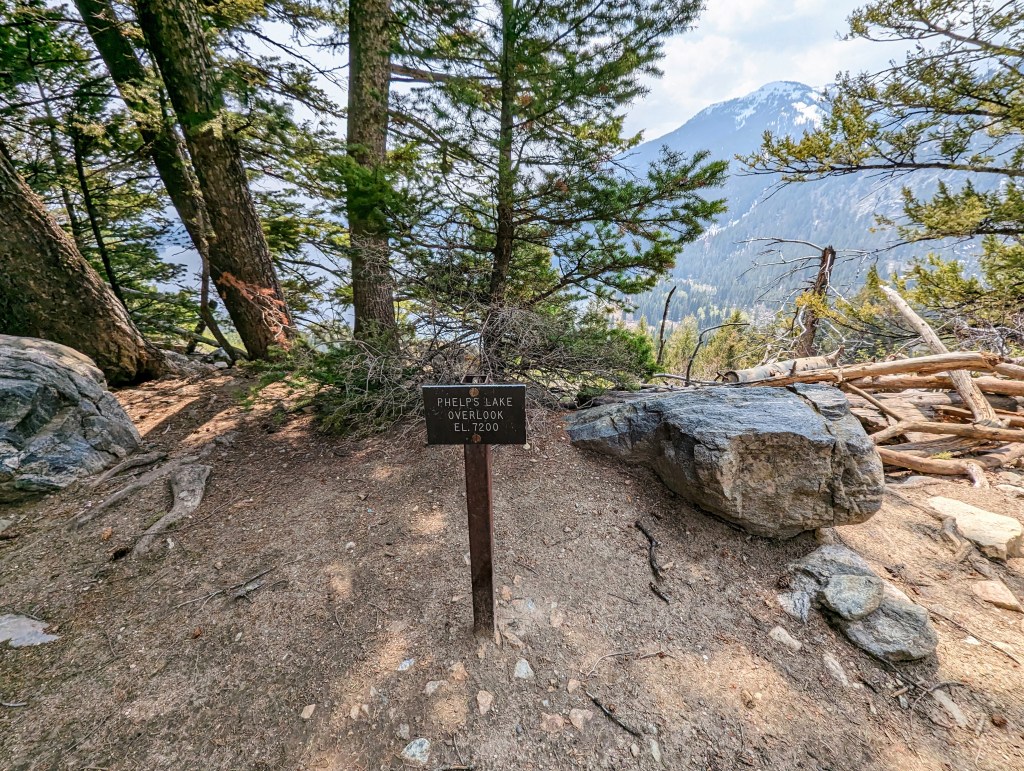
In her collection of photos was one of Aaron standing at this signpost when he was about eight years old. Tears, which were threatening all day, suddenly arrived with a flood.
Her boy had always been a child at the overlook, except at the end. Aaron walked the trail alternating in wonder, indifference and complaint. He was here not by choice, but because his mother wanted it so. To her, each hike happened yesterday. But the earliest trips were a blur to him. So she was alone with those memories.
The movie “Cinema Paradiso” came to mind. There a censor directed the projectionist Alfredo to cut romantic scenes from films before the villagers could watch them.
The townsfolk suffered through years of incomplete screenings in this way. After the projectionist’s young protege Salvatore grew up, he found Alfredo’s roll with those missing frames spliced together – an ode to romantic love. But Cinema Paradiso was being torn down – Salvatore was left to watch Alfredo’s reel by himself. ¹
Likewise, the motherly scenes with Aaron were there in her head. But only she could watch them.
Don Miguel Ruiz wrote of movies metaphorically in “the Fifth Agreement.” He suggests that we are each making a motion picture, with ourselves as the star. In our movie we are the lead, and everyone else are supporting actors. But while they act in ours they are also directing their own stories. To watch their films we would be surprised at our diminished roles, and that our performances are often seen differently from our intent. ²
Megan realized that Aaron’s movie had highlights of his own experiences, and his most cherished memories of his mother were mostly not the same scenes as hers.
She sighed, and scanned the lake below. Here at the overlook was a view of both where she had been and where she was going.

Friedrich Nietzsche wrote that the “formula for greatness in a human being is “amor fati.” One wants for nothing to be different, not forward, not backward, not in all eternity. Not merely bearing what is necessary… but loving it.” ³ This was her lot now, to hike without Aaron, so she would embrace it.
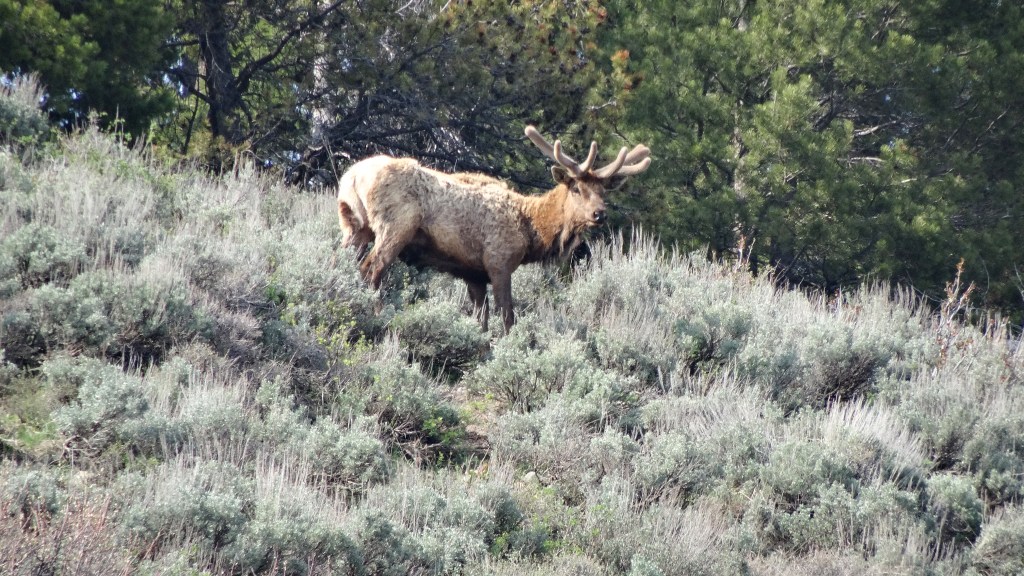
Megan started back down the trail, returning via the other side of the lake. The large “jumping rock” passed by – a popular summer swimming destination of the locals. A solitary hiker strode up from the other direction – the fifth and last person she would see in the valley today. With three elk, two moose, and three marmots, there were more animals than humans for company.


Several boulders appeared at the edge of the water, and here was another spot where mother and son rested years ago. Megan saw the child sitting on one of the rocks smiling at her, a snack in a little hand.
How lucky she was to have all these memories of her son on this trail, even if he didn’t remember. This is after all, amor fati. How empty those years would have been without him. Her little trail buddy, now a man, had filled those years with laughter, frowns, and love.
With cheeks still showing the tracks of her tears, she smiled.
——————–
The Overlook © 2023-25 by Dean Jen
¹ Giuseppe Tornatore, “Nuovo Cinema Paradiso,” Titanus, 1988.
² Don Miguel and Don Jose Ruiz, “The Fifth Agreement…” Amber-Allen, San Rafael, 2010.
³ Friedrich Nietzsche, “Ecce Homo: Wie man wird, was man ist.” Insel-Verlag, Leipzig, 1908.


 Dean Jen
Leave a comment