A farmer watched in resignation as her horse galloped away. At first with a bluster of pounding hooves, then with diminishing thunder as the equine grew smaller in the distance.
Her neighbor, who had heard the commotion, shouted condolences. “Bad luck my friend.”
“Perhaps,” said the agrarian.
Weeks later the steed returned, flanked by several companions. The same neighbor came to convey congratulations. “How nice!”
“Perhaps,” was the reply.
The farmer’s son took to caring for the herd, but one day fell as he rode, breaking a leg. The neighbor came over to help set it. “How unfortunate for your boy,” she whispered to the mother.
“Perhaps,” was the answer.
Soon after, local gendarmes visited the valley to draft young men needed at the northern border. Only the boy with his broken leg was left behind. The neighbor remarked on the good luck the injury had brought.
“Perhaps.” ¹
——————–
Dan thought of the farmer and horse. He was trying to decide if the recent breakup of a relationship was a bad or good thing.
He remembered his own counsel – previously repeated to a friend or two, when they had experienced similar inflection points. “New beginnings are often disguised as painful endings.” This would be his lesson now too.
Shadows were growing long at the lodge in Big Bend. Dan was relaxing on the patio when a man approached him, in cowboy boots seemingly not yet accustomed to his feet. His gaze was piercing, looking out from under a cowboy hat, perhaps not yet accustomed to his head. The interlocutor had a beard not quite as gray as his own.
“Sir, I wonder if I might ask about the formalities for dinner – perhaps you know this place, since you seem to be sitting at ease.”
“Oh, I suppose the dining room will open for supper soon. Casual attire for sure. Folks here are not much for dress codes or etiquette. After all, most come to the park for a rustic experience of nature.”
The other man looked a bit disappointed.
“Thank you sir. Although I was hoping for at least a modicum of civilized tradition. Rituals can bring harmony to shared experiences.”
Dan smiled as he watched the man shuffle away. His smile grew wider as he realized the man was wearing wrangler jeans with his name branded onto the back of his leather belt. “Kong.” The “name belt” is an old Texas tradition, but he hadn’t seen one in a long time.
“How considerate of him. Trying to adopt the customary garb of the locals.”
The next day Dan rose early and strode to the end of the parking lot where the hiking paths began. Here in darkness a ranger was standing with light, notebook, and pen. “Would you mind writing something in the trail log? We don’t usually keep a journal, but this month marks the eightieth anniversary of the South Rim opening. I heard you talking yesterday at the lodge. You’ve been to the park many times, so we could partake of your wisdom and an anecdote or two, if you have them. Write what you want.”
Dan took up the journal and the pen, noticing the latter was wrapped in masking tape with perhaps the ranger’s initials written on it – “YX.” He jotted in the logbook under his headlamp for a while – longer than he initially anticipated. Finally he handed the ledger back to the ranger, who had been surprisingly patient – but then there weren’t many other visitors awake yet.
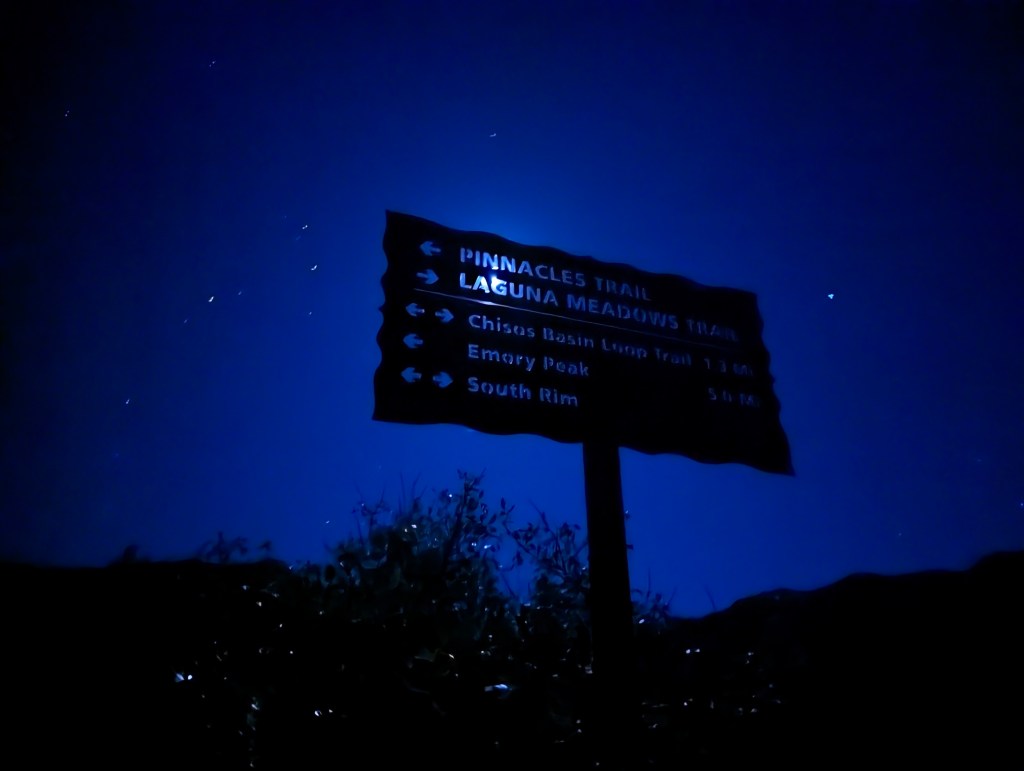
He started walking at a brisk pace, the sky gradually brightening. After a while a fork appeared. Would he take the gentler rise of Laguna Meadows, or the more aggressive switchbacks of Pinnacles? Either would work.
John Muir once said, “People ought to saunter in the mountains, not hike.” Muir went on to explain. “Back in the middle ages folks made pilgrimages to the Holy Land, and when people in the villages through which they passed asked where they were going the reply often was, ‘A la sainte terre,’ ‘To the Holy Land.’ And so the walkers became known as sainte-terre-ers or saunterers. Now these mountains are our Holy Land, and we ought to saunter through them reverently, not ‘hike’ through them.” ²
Muir took his time walking in the mountains – usually the last to arrive, always talking to those he met on the trail, enjoying the views, and communing with nature. Dan decided he would likewise enjoy his saunter today, at an easy pace.
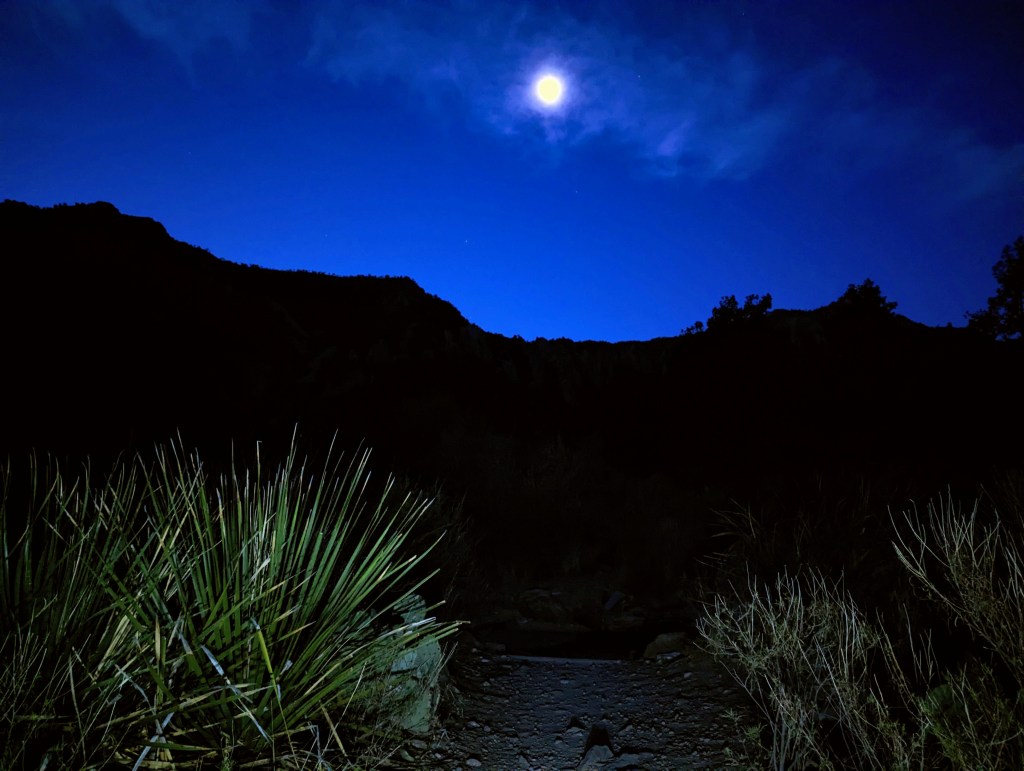
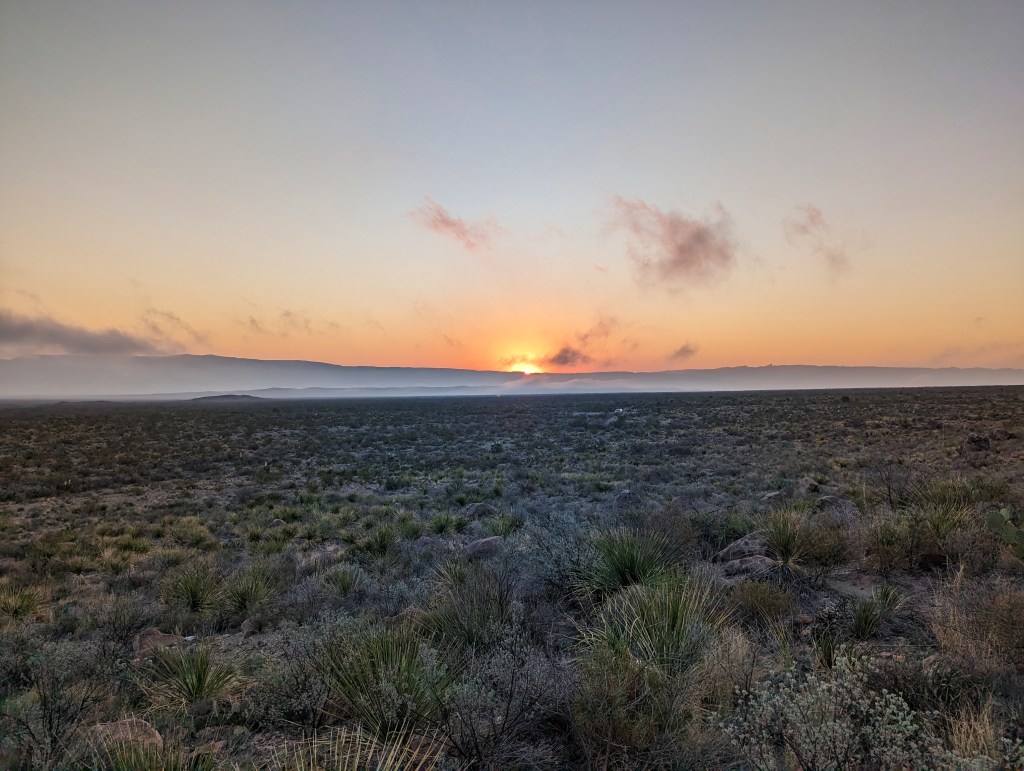
Mesquite and juniper appeared out of the gloom as day broke, joined by piñon and madrone. A break in the foliage allowed him to enjoy a view down into the valley he had just left.
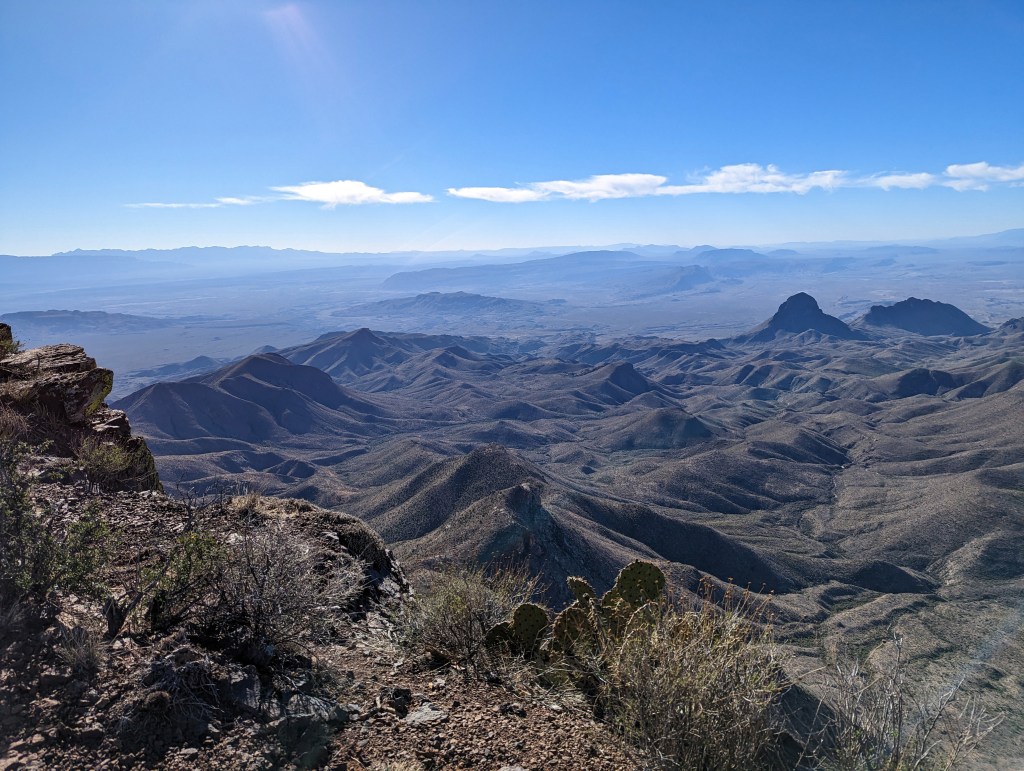
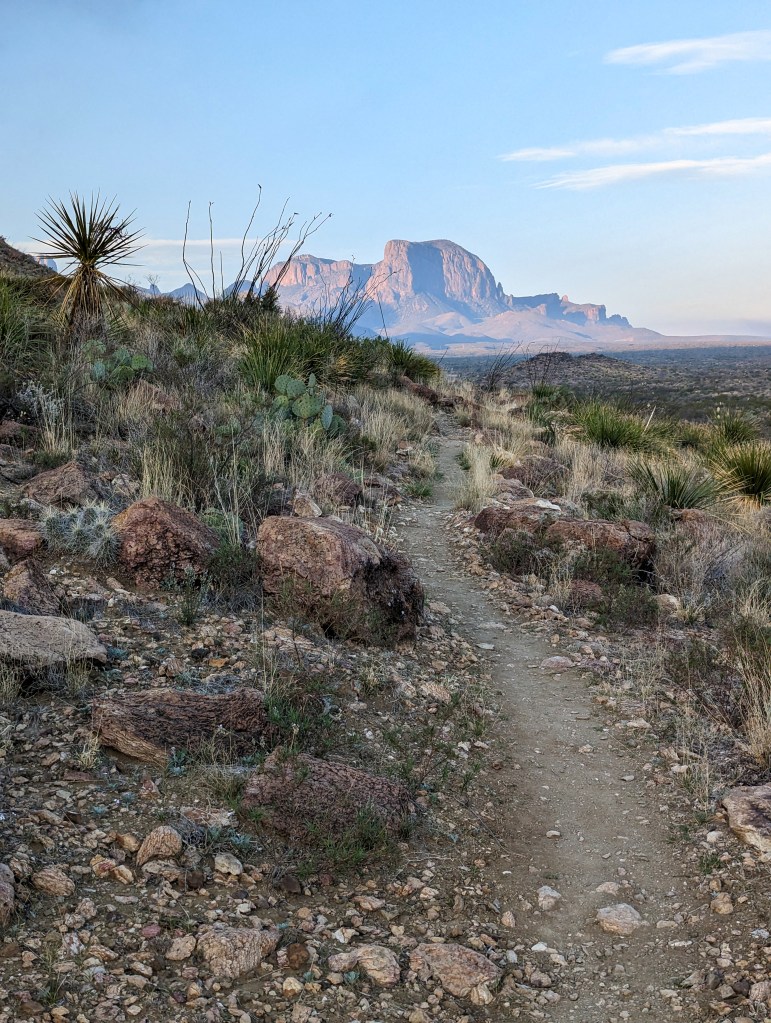
The climb to the ridge went quickly despite his languid gait. After the Pinnacles he passed over the mostly dry creek in Boot Canyon. Upon crossing a grassy field he was suddenly on the South Rim. Here he seemed to be standing on a wall, gazing into a sunken landscape which stretched for miles. Smoke from far-away wildfires had drifted across the arid terrain, dulling some of the sharpness but not the grandeur. In the distance past Mule Ears, he could see Mexico – with Santa Elena canyon carved into the escarpment. Below it a green streak snaked across the valley showing the course of the Rio Grande.
A shaded rock offered perch for a snack. Here he reflected that his ex had taught him well. “When the student is almost ready the teacher will appear. When the student is truly ready, the teacher will disappear.” ³ Maybe it was that simple. She had left because he was ready for what was next.
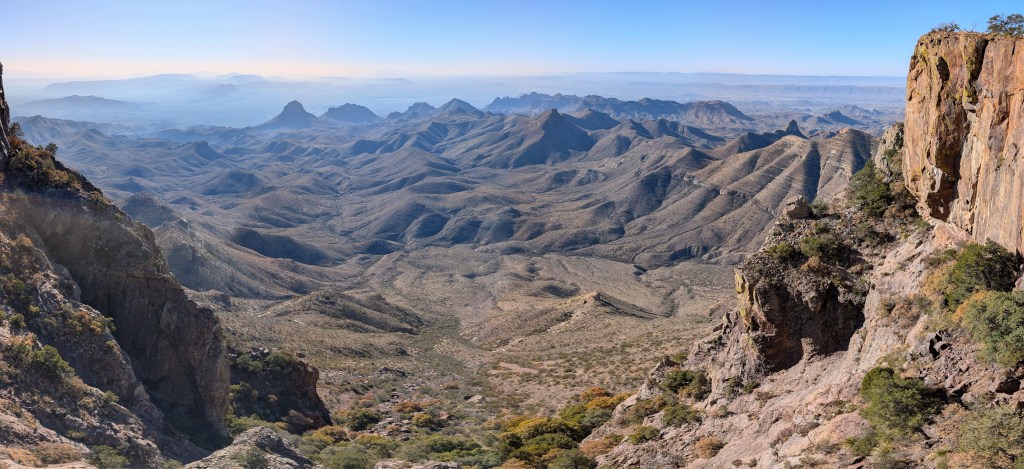
In the ranger’s journal that morning he had written, “The greatest space has no borders.” Now he reflected that the space we hold for love does not expand or contract with the presence or absence of the object of our devotion. Dan’s love could be indifferent to whether his ex was with him or not.
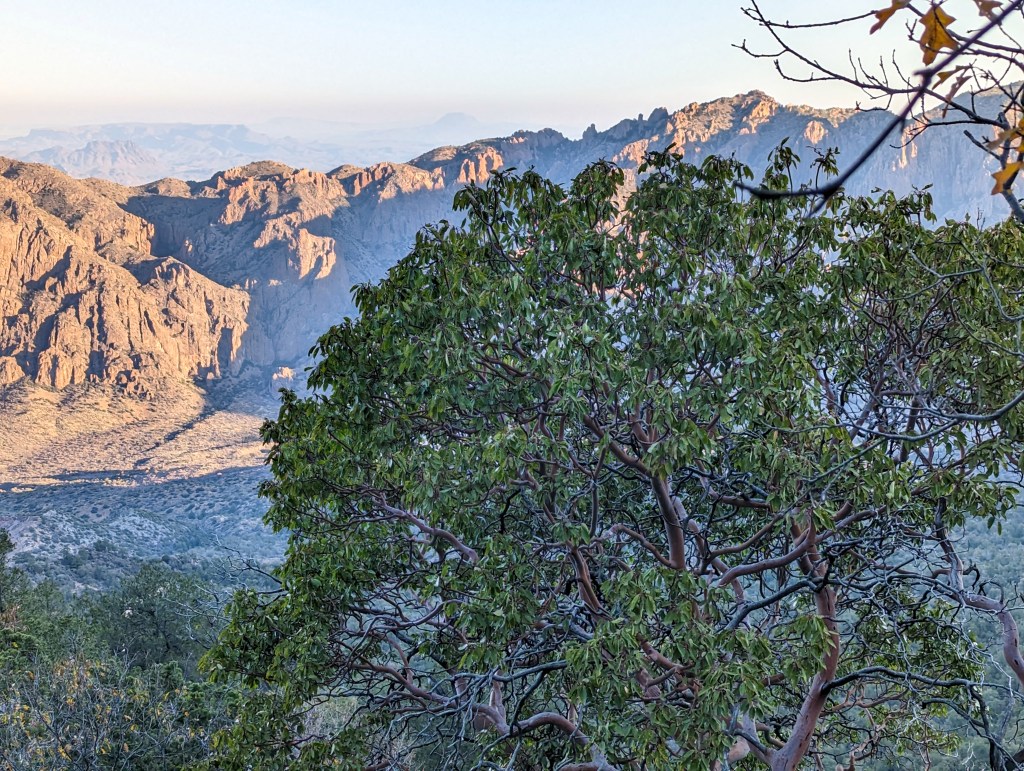
His feet continued around the loop trail, finally taking a turn-off which led into the valley below. Descending along this path another hiker came into view, sitting under a madrone tree. The tree’s bark was peeled back, exposing a pink-orange trunk. Despite the different appearance of bark and leaves, the madrone’s shape reminded Dan of a giant fig tree.
The man sitting in its shade spoke. “Hi, my name is Sid. Please join me.” He beckoned with a hand to a spot on the rug next to him.
“What brings you along the trail – where are you headed?”
“That is a good question. The path which can be described is not the path we are on.”
Dan saw a quizzical expression on the tramontane’s face.
“So I wrote in the trail log earlier today. Perhaps it means that my way will only be understood when looking back – after finishing this part of my journey. It may be that I came here to talk to you.”
“Very well then. Perhaps I came here to fulfill that obligation. Pray, sit and tell me a story.”
Dan sat on the rug. “Have you heard about an old man named Laozi?”
Sid raised an eyebrow.
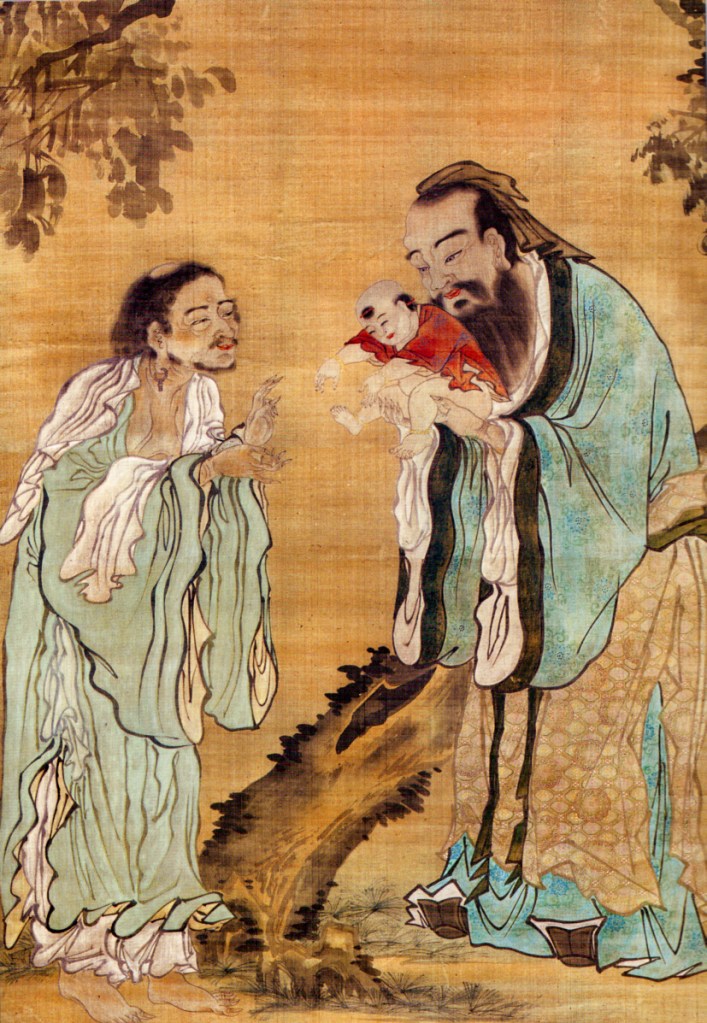
“Around 500 B.C.E. or thereabouts lived a man named Li Dan. He was a minor official – an archivist, when visited by a contemporary, a man named Kǒngzǐ from a neighboring state. The visitor inquired about some mundane rule of rites or formality – perhaps about the setting of tableware during an official dinner. Later the visitor would be known in the West as Confucius.”
“For Confucius, rituals were an important aspect of living – for they were reminders of virtue. Respect of tradition and social norms imbue our duty to be kind to our neighbors. He believed that rituals and rites would keep us on the path of virtue. By conscious adherence to these traditions, society remains just and happy.”
“Li Dan however, expressed something different in a book he was to write later. There he proposed that rituals are only a surface manifestation of virtue:
“When the Way is lost there is goodness.
When goodness is lost, there is morality.
When morality is lost, there is ritual.
Ritual is the husk of true faith,
The beginning of chaos.” ¹
“Thus the way to virtuous living is by acting in accordance with our innate nature. A dove does not practice being white, nor does a crow try to be black. Our essence at birth is virtuous, and inner peace comes from returning to that original state. There, goodness and morality become us. Practice, or ritual, is unnecessary.”
“The menu is not the meal, the map is not the place – nor is the ritual the virtue.”
Here Sid interjected, “Yes, it is the finger pointing at the moon. If we focus on the finger we do not see the moon – and yet sometimes we need the finger to show us the way. Perhaps that is what Kǒngzǐ meant.”
Dan nodded.
“Despite their differences, it is reported that Confucius was impressed with Li Dan, who later became known as Lao Tzu or Laozi. Some time after their meeting, Laozi decided to leave China, and made his way to the Great Wall. Looking over the ramparts, he saw a high desert stretching into nothingness to the west. Here he was recognized by the captain of the gate Yin Xi, who asked Laozi to share some of his wisdom before he left. Laozi drafted a series of verses and handed these to the captain. This manuscript became the Dao De Jing, a guide to living our best lives, which has come down to us through the ages.
Where Laozi went afterward no one knows, but some suppose he traveled to Bodh Gaya in India, where he met a man named Siddhartha Gautama. Siddhartha is associated with the Bodhi fig tree, under which he is said to have studied and attained enlightenment or buddhahood.”
“An interesting story! What do you think became of Laozi?”
“Some say he prospered and he or at least his descendants later returned home.”
“And what of you Dan? The path you are on is not the path you can describe. But perhaps that is not the path to question. I would be satisfied knowing where your feet will take you next.”
Dan stood up and hoisted his pack onto a shoulder. He remembered something scrawled into the logbook that morning. Turning to Sid he said, “I would tell myself to stop leaving and I will arrive. Stop searching and I will see. If I cannot find what I am seeking, it is because what I seek is already in my possession.”
He smiled and added, “So I will return to the trailhead.”
And then, “To hold, I must first open my hand to let go. By letting go it all gets done.”
“I lost someone recently – she left me. In accepting her loss, I begin to understand why the greatest love seems indifferent. Our capacity for this emotion expands beyond the object of our devotion. In the end, her presence or absence is indifferent to my nature. When we radiate love, it returns to us – the heart that gives, gathers.”
“The space between the heavens and the earth is like a bellows,
Empty and yet inexhaustible.
The more we use it, the more it produces.” ¹, ⁴
He thought of his ex. The pain was suddenly less. It may never go away entirely. But he knew to appreciate it now.
——————–
Copyright 2023-25 by Dean Jen
——————–
¹ Stephen Mitchell, “Tao Te Ching,” Harper Collins, New York, 1992.
² Albert W. Palmer, “The Mountain Trail and Its Message,” The Pilgrim Press, Boston, 1911.
³ Bruce R. Linnell, “Dao De Jing: A Minimalist Translation,” Project Gutenberg, 2015.
⁴ Tim Chilcott, “Dao De Jing,” Tim Chilcott Literary Translations, UK, 2005.
 Dean Jen
Leave a comment