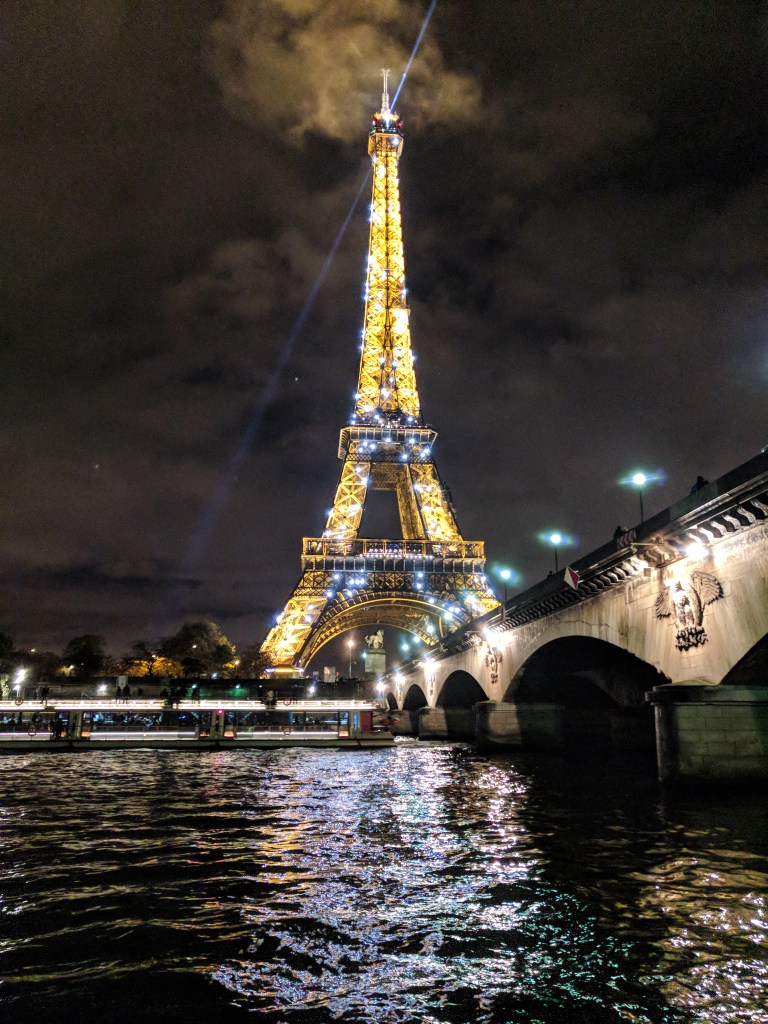
The tower was bathed in light – to such an extent that the very metal glowed luminous.
Venturing to Paris between client visits in London and Frankfurt, my last bathroom break had been at McDonald’s on les Champs a while ago. I needed to find a café soon.
The girl was sitting at an outside table with a book entitled “Les Séminaires.” Reading, she probably did not want to be disturbed. But the words came.
“Love is giving something you don’t have to someone who doesn’t want it.” ¹
She looked up as I spoke. The tome was in French, so it was a roll of the dice. But there was no alternative.
Her eyes met mine before a slight smile appeared.
“Vous connaissez les Séminaires?”
My heart sank. Disappointment must have reflected on my face, because her smile grew wider. “What do you know of Jacques Lacan?”
“It depends. Do you believe in love?”
“An American asking a Parisienne about love?” She was still smiling.
I drank in her gaze for a moment before replying. “That would be yes? Then let me defend the other side of the argument, to keep the conversation interesting.”
“Ah. Monsieur, sit and tell me more.”
I accepted her invitation while she continued.
“What do you know of love – you have read Lacan, yes? Now tell me why you would not believe.”
An impossible conversation lay ahead – sitting across from a stranger discussing the most mysterious emotion without preparation. My mind searched to articulate recollections of the Seminars.
“Lacan conveys Plato’s myth that Love is the child of Porus (plenty) and Penia (poverty). Penia conceives Love by giving the only thing she has – poverty, or lack, to Porus – who is drunkenly unaware – therefore receiving something he did not ask for. Lacan uses this tale to illustrate that love is born when someone gives something they lack to their mate – who doesn’t want it.”
“Ah yes, I am just at that part of the book.”
I continued. “One cannot give what one does not have – the missing part of our partner which they think we can provide. So what we do give is unwanted. Likewise our own need projects onto our mate, which they in turn cannot fulfill. Romantic love is therefore ephemeral. If lucky, we are left with a friendship – lovers who help each other become better versions of ourselves. Or as Tatkin’s book states in the forward – a partnership which creates a container for the joy of being.” ²
She took a sip of tea before responding.
“I concede your point. You feel I can provide something missing in yourself. If I share this attitude about you – we fall in love. Later we discover that we do not have the other’s missing piece – which can only be provided by ourselves.”
“But what of the dance? Surely you have been in love, and was it not – how do you say, incroyable?”
“The dance is just the body’s reaction to our thoughts – in this case, of desire.”
We continued the conversation over the next hour. It had been a while since I had read, or more accurately scanned some of Lacan’s seminars – but my remarks kept her engaged. Somewhere in that hour I did manage to visit the restroom.
The night turned chilly. “Let’s go for a walk.”
We stepped across the street and were soon strolling along the Seine.
Her arm slipped through mine and she pulled in close. I was glad for the cold breeze.
“You are very charming. I do not usually invite a strange man to sit at my table.”
“Camus, a fellow Parisian, once defined charm as getting to a yes without asking a question. My first words to you came without much thought – certainly without intention. Perhaps it was not charm but fate.”
“Fate brought us together? And this from someone who does not believe in love.”
We sat on a bench looking at la tour, arm-in-arm. Long periods passed without words spoken. At one point she took a hand away to brush the hair from her face. When her hand came back it found mine.
“We must cherish someone for who they are, and not for who we want them to be.” She let the words hang, for so long that I surmised she had finished – but then she continued. “Our partner is not here to complete us. If we accept each other as we are – in our imperfection, we can believe.”
It was late, or rather early. The ease of being in her presence began to slip away, replaced by anxious thoughts. My train was later in the morning, followed by a client visit the next day. And yet life’s journey had brought me to this woman and it would soon be over, perhaps in a matter of minutes. But then came surrender. The universe had a plan. It was mine to embrace, whatever came. Returning to the touch of her hand in mine, I found again the joy of being.
“I like you. But a long distance relationship is not for me.” She turned her face to mine – close now. Her breath caressed my cheek, her eyes glistened, reflecting light from the tower. The words came softly. “Will you move to Paris?”
Surprised, my lips remained silent.
“I’d like to see you again,” she whispered. “But we must not invest the energy if you do not live in my town.”
I thought of the possibilities, and began to wonder if I did believe in love after all.
—————————
Paris © 2021-2024 by Dean Jen
¹ Jacques Lacan, Le Séminaire, Livre VIII, 1961, published by Seuil
² Harville Hendrix, Tatkin’s Wired for Love, 2011, by New Harbinger





 Dean Jen
Leave a comment